Bulgaria Rejects Gambling Ad Ban and Tax Hike in 2026
Parliament blocks opposition plans to nearly double operator fees and impose a total advertising ban, keeping the 25 percent GGR tax and partial ad rules in place
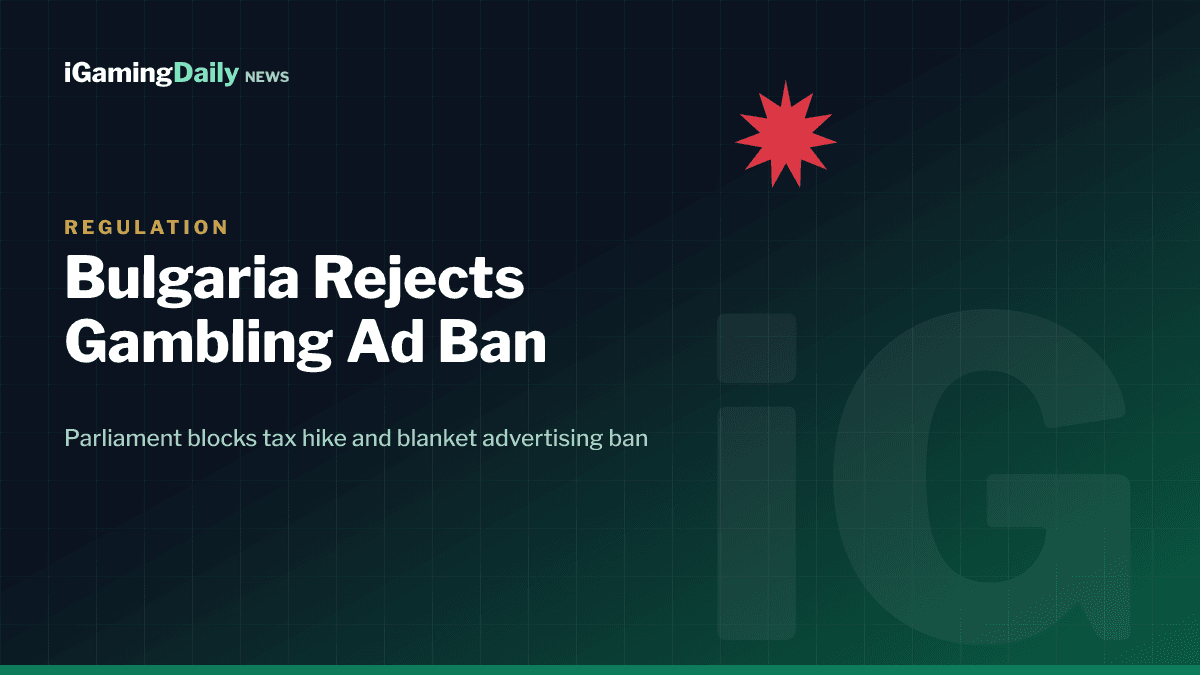
Bulgaria's National Assembly has rejected opposition proposals to nearly double gambling operator fees and impose a total ban on gambling advertising. The vote, reported on July 22, 2026, leaves the country's existing 25 percent tax on gross gaming revenue (GGR) and its partial advertising restrictions in place, with the ruling coalition citing the risk of pushing players into Bulgaria's unlicensed gambling market.
Key facts
- Bulgaria's online gambling tax stays at 25 percent of GGR, a rate already raised from 20 percent earlier in 2026, according to iGaming Business.
- Corporate tax on licensed operators remains at 10 percent.
- Bulgaria's legal channelization rate, the share of gambling spend going through licensed operators rather than unlicensed sites, sits at roughly 60 percent, per the Finance Ministry.
- Gambling advertising has been banned on TV, radio, print and most digital channels in Bulgaria since April 2024, with narrow carve outs for the state owned Bulgarian Sports Totalisator.
What did Bulgaria's parliament vote on in July 2026?
Bulgarian MPs voted down two linked proposals from the opposition parties We Continue the Change and Democratic Bulgaria: a near doubling of the fees operators pay to hold a gambling licence, and a blanket ban covering every remaining form of gambling advertising still permitted under the country's 2024 rules. Both measures failed to secure a majority, and lawmakers instead approved only a narrower, additional tax targeting a specific niche of the sector, leaving the broader framework unchanged.
Who proposed the gambling ad ban and fee increase?
The rejected amendments came from We Continue the Change and Democratic Bulgaria, the two parties that have pushed the hardest for tighter gambling controls since the country's 2024 advertising reform. Their proposal would have removed the remaining exceptions in Bulgaria's ad rules, closing off billboard and outdoor advertising alongside the TV, radio and print channels already off limits, while also raising the licence fees operators pay to the state.
Why did the government reject the tax and ad proposals?
The government's objection centered on channelization, not principle. Deputy Finance Minister Lyudmila Petkova told parliament that "any increase before taking measures to limit the grey sector means shifting players from the legal to the illegal market," arguing that squeezing licensed operators further, without first tackling unlicensed competition, would simply push Bulgarian bettors toward offshore sites outside the tax base and outside consumer protection rules entirely.
What are Bulgaria's current gambling advertising rules?
Bulgaria already runs one of the stricter advertising regimes in the European Union. Since April 2024, gambling ads have been banned outright on television, radio, print and the majority of digital platforms, with the state owned Bulgarian Sports Totalisator carved out as the sole exception. Billboard advertising is still allowed, but only at locations more than 300 meters from schools, universities and playgrounds, and at least 10 percent of any billboard's surface area must carry a gambling harm warning. Advertising on buildings is capped at 50 square meters or 20 percent of the facade, whichever is smaller. The proposal rejected this month would have removed the billboard exception too, leaving operators with essentially no legal advertising channel inside Bulgaria.
What is Bulgaria's current gambling tax rate?
Licensed online gambling operators in Bulgaria pay 25 percent of GGR, a rate that itself only rose from 20 percent earlier in 2026, alongside a standard 10 percent corporate tax. The rejected opposition amendment would have pushed operator fees close to double that level. The Finance Ministry's position is that Bulgaria has already tightened the tax burden once this year and wants to assess the effect of that change, and of a parallel push to license gambling affiliates announced in July 2026 (see SBC News), before tightening further.
How big is Bulgaria's unlicensed gambling market?
The Finance Ministry puts Bulgaria's channelization rate, the proportion of gambling activity flowing through licensed, tax paying operators, at around 60 percent. That leaves an estimated two in five euros staked by Bulgarian gamblers going to operators outside the regulated system, a gap the ministry says would widen, not narrow, if legal operators faced both a steeper tax bill and a total advertising blackout that offshore sites simply ignore.
What did MPs approve instead of the rejected proposals?
Rather than the broad fee increase and advertising ban, parliament approved only a narrower, additional tax measure focused on a specific niche within the sector, according to reporting from iGaming Business. The government has signaled that a more comprehensive revision of Bulgaria's gambling legislation is still in preparation at the Finance Ministry, suggesting July's vote was a rejection of this specific package rather than a closing of the door on future reform.
Has Bulgaria rejected similar gambling restrictions before?
Yes. Bulgarian lawmakers have blocked comparable proposals before, including a package from the nationalist Vazrazhdane party in 2024 that sought a full advertising ban, a mandatory two year self exclusion period and a shift from licence fees to a 15 percent tax on customer deposits. That measure also failed, in that case because most MPs abstained rather than voting it down outright. The recurring pattern points to a parliament that supports stricter consumer protection in principle but keeps rejecting the specific mechanism of a blanket ad ban paired with a sharp tax rise.
How does Bulgaria's approach compare to other EU gambling markets?
Bulgaria's stance, tight advertising limits paired with a moderate, gradually rising tax rate, sits between two more extreme EU approaches. The Netherlands and Italy have moved toward near total gambling advertising bans regardless of channelization impact, while markets such as the UK have kept broadcast advertising legal but layered on affordability checks instead. Bulgaria's government is explicitly betting that channelization, keeping players inside the licensed system, matters more for player protection and tax revenue than the strictest possible advertising rules.
| Measure | Rejected proposal (July 2026) | Current rule |
|---|---|---|
| Operator licence fees | Near doubling | Unchanged, 25 percent GGR tax stands |
| Advertising | Total ban, including remaining billboard exception | Banned on TV, radio, print, most digital; billboards allowed 300m plus from schools |
| Billboard warning space | Not addressed | Minimum 10 percent of surface area |
| Corporate tax | Not addressed | 10 percent |
What does this mean for operators licensed in Bulgaria?
For now, licensed operators keep the advertising channels and tax rate they already had, including the billboard option that would have disappeared under the rejected proposal. But the Finance Ministry's comments make clear this is not a signal that regulation is loosening. A broader legislative revision is already being drafted, and the parallel move to require licensing for gambling affiliates shows the government is tightening the system from a different angle, oversight of who promotes gambling, rather than through an outright ad ban.
What happens next for Bulgarian gambling regulation?
Bulgaria's Finance Ministry has said it is preparing a more comprehensive revision of gambling legislation, and the affiliate licensing push announced in July 2026 suggests the next round of tightening will target distribution and marketing partners rather than operators' core tax rate. Industry watchers should expect the channelization argument, that overregulation drives players offshore, to remain the government's central justification whenever new restrictions are proposed.
FAQ
Did Bulgaria ban gambling advertising in 2026?
No. Bulgaria's parliament rejected a proposed total ban on gambling advertising in July 2026. The country's existing partial ban, in place since April 2024, remains: TV, radio, print and most digital ads are prohibited, but billboards are still allowed under strict placement and warning label rules.
Did Bulgaria raise gambling taxes in July 2026?
Parliament rejected a proposal to nearly double operator licence fees. The online gambling tax rate stays at 25 percent of GGR, the level it was raised to earlier in 2026 from 20 percent.
Who proposed Bulgaria's rejected gambling ad ban?
The opposition parties We Continue the Change and Democratic Bulgaria proposed the rejected package of a blanket advertising ban and higher operator fees.
Why did Bulgaria's government reject the proposals?
Deputy Finance Minister Lyudmila Petkova said further tax and advertising restrictions, without first addressing Bulgaria's unlicensed gambling sector, would push players from legal to illegal operators.
What is Bulgaria's channelization rate?
Bulgaria's Finance Ministry estimates that around 60 percent of gambling activity in the country flows through licensed, taxed operators.
Updated July 2026.
More from iGaming Daily
Cambodia Shuts 72 of 195 Licensed Casinos in Year-Long Online Fraud Crackdown
Poland's 12% Turnover Tax Is Driving Players to Illegal Online Casinos

PAGCOR Privatization Could Cost Philippines Healthcare P2.1 Billion a Year