Italy Gambling Tax Revenue 2026: Why the Treasury Expects an 800m Euro Boost
A reformed online licensing regime, higher GGR tax rates and 52 fresh concessions underpin Rome's forecast, even as early 2026 receipts dipped.
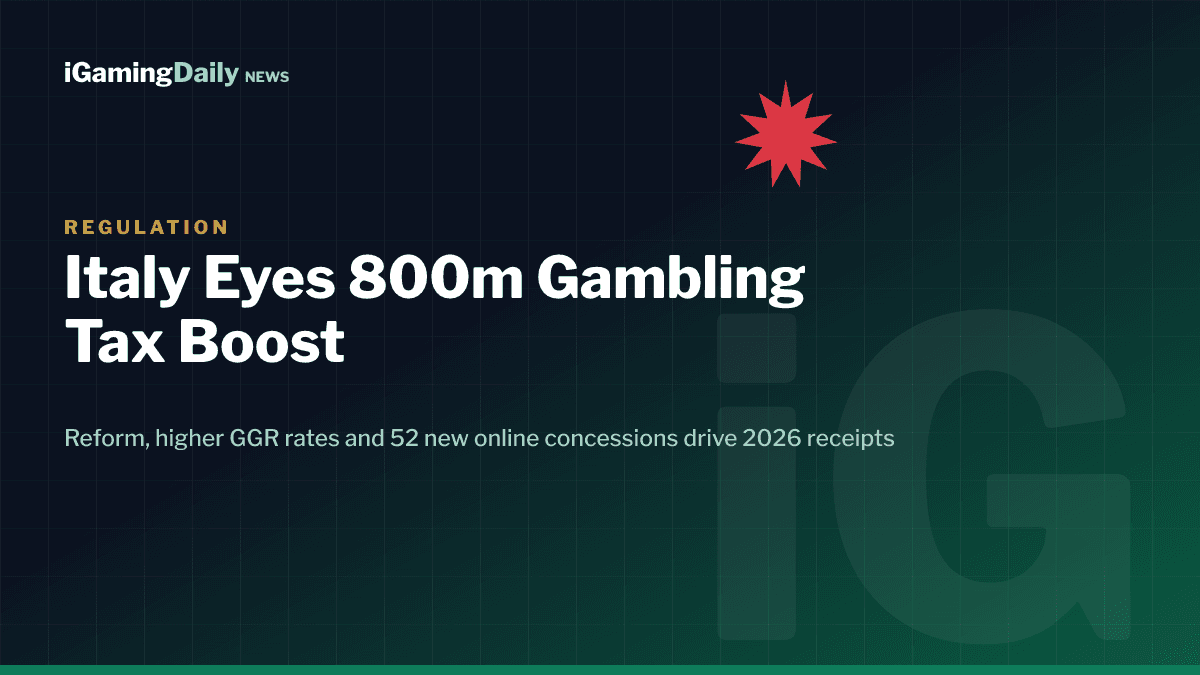
Italy expects gambling and betting to deliver roughly 807 million euros in additional receipts in its 2026 budget assessment, a jump credited to a reformed online licensing regime, higher tax rates on gross gaming revenue and 52 new nine-year concessions that came into force from late 2025. The forecast, drawn from the Senate dossier on the 2026 budget adjustment and reported by Italian trade outlet AGIMEG, marks a sharp turnaround in tone for Europe's largest regulated gambling market, even though actual receipts slipped in the opening months of the year.
How big is Italy's projected 2026 gambling tax boost?
The headline number is an increase of about 807 million euros in gaming and betting revenue for the 2026 assessment, measured against Italy's 2025 final accounts. The figure sits inside a broader rise in non-tax state revenues of just over 4 billion euros, with gambling identified as a substantial contributor. It is a projection of growth rather than money already banked, and it rests on the assumption that the new licensing and tax framework beds in as designed across the full year.
Key facts at a glance
- Projected boost: about 807 million euros in extra gambling and betting receipts in the 2026 budget assessment.
- 2025 baseline: Italian gambling licences generated roughly 6.66 billion euros in taxes and duties.
- Early-year dip: 2.52 billion euros collected from January to April 2026, down 7.8% year on year.
- New online concessions: 52 remote concessions under the reformed regime, projected to add around 365 million euros.
- Licence fee: 7 million euros per vertical and per brand, for a nine-year term.
- Tax rate changes: online sports betting GGR tax lifted from 24% to 24.5%, online casino, poker and bingo from 25% to 25.5%.
What is driving the increase?
Three forces sit behind the forecast. The first is the reformed online licensing regime that opened from November 2025, under which operators paid a one-off fee of 7 million euros for each vertical and brand to secure a nine-year concession. That upfront cash, spread across dozens of concessions, is projected to contribute around 365 million euros on its own. The second is a modest but broad increase in GGR tax rates. The third is the sheer scale of the Italian market, where regulated remote gross gaming revenue runs at roughly 5.2 billion euros a year, so even small rate changes move large absolute sums.
How much did the tax rates actually change?
The rate moves are incremental rather than dramatic. Online sports betting now carries a 24.5% levy on gross gaming revenue, up from 24%, while online casino, poker and bingo pay 25.5%, up from 25%. Alongside those headline rates, operators face an annual fee of 3% of GGR and a responsible gambling spending requirement of at least 0.2% of GGR, capped at 1 million euros. Combined, the tax measures have been estimated to deliver more than 500 million euros in additional annual tax revenue at maturity.
Why did receipts fall earlier in 2026 if a boost is coming?
This is the paradox in the data. Between January and April 2026, Italy collected 2.52 billion euros in gambling receipts, a 7.8% fall against the same period in 2025. Part of that reflects the transition itself, as the market moved onto the new concession structure and some operators exited. The budget forecast bets that the full-year picture, boosted by concession fees booked during 2026 and a stabilised operator base, more than offsets the soft start. In other words, the 807 million euro figure is a full-year projection that looks through a bumpy first quarter.
How does the reform reshape the operator market?
The licensing overhaul is as much about consolidation as revenue. Industry analysis points to the number of remote operators shrinking from around 81 toward the low thirties, a decline of roughly 60%, as the elevated 7 million euro entry fee prices out smaller brands. The previous tender attracted 93 applications; the reformed round drew closer to 50. The expectation is that a top tier of operators ends up controlling something in the region of 80% of remote GGR, with Flutter Entertainment, strengthened by its Snaitech ownership, positioned near the front of the pack.
"The reform has brought the price of the licence to a normal level. The previous price, how cheap it was, that was the abnormal part," said industry adviser Christian Tirabassi, framing the higher fee as a correction rather than a penalty.
How does Italy compare with other markets raising gambling taxes?
Italy is far from alone in leaning on gambling for fiscal headroom. In the United Kingdom, tax pressure has already pushed operators to cut costs, with Entain moving to cut 500 jobs as duties bite. In Asia, Macau's gaming tax revenue rose 13% in the first half of 2026 on the back of a recovering land-based sector. The table below sets Italy's approach against those reference points.
| Market | 2026 tax signal | Key driver |
|---|---|---|
| Italy | About 807m euro projected receipts boost | Licensing reform plus higher GGR rates |
| United Kingdom | Rising duties, operator cost cuts | Tax rises squeezing margins |
| Macau | Tax revenue up 13% in H1 2026 | Land-based recovery |
What role does the 2026 World Cup play?
Timing matters. The forecast lands in a year when a men's football World Cup is stoking betting volumes worldwide, a wave that has lifted operators from Latin America to Europe and shaped how much bookmakers stand to make from the World Cup. Heightened sports betting turnover feeds directly into GGR, and therefore into the 24.5% levy, giving Rome an additional tailwind during the tournament window even if the underlying reform is the structural story.
Who are the key officials behind the reforms?
Deputy Minister of Economy and Finance Maurizio Leo has been steering the wider gambling reorganisation, including a land-based decree negotiated with regional authorities. Sports Minister Andrea Abodi has been preparing a media and advertising bill intended to replace the 2018 Dignity Decree ban on gambling advertising, a change with direct implications for how operators can market and, in turn, grow taxable revenue. Separately, newly elected Italian Football Federation president Giovanni Malago has floated a 2% levy on football betting revenue to fund grassroots programmes, a proposal that signals how central gambling money has become to Italian sport funding debates.
What is the timeline for the rest of the reform?
The government has signalled it wants the core of its gambling reforms completed by the end of August 2026, ahead of the 2027 election cycle. That includes finishing the land-based reorganisation and advancing the advertising overhaul. For operators, the practical implication is that the regulatory ground is still shifting, and the revenue projection depends on those pieces landing broadly on schedule.
What does it mean for operators and players?
For operators, the message is that access to Italy now costs more and demands more, but the reward is a cleaner, more consolidated market with a long nine-year runway. Smaller brands face a genuine question over whether the economics work. For players, consolidation could mean fewer licensed brands to choose from, though the regulated perimeter is designed to be more robust and better funded on responsible gambling. For the treasury, gambling is confirmed as a dependable line item in the national accounts, one Rome is actively engineering to grow.
Frequently asked questions
How much extra gambling tax does Italy expect in 2026?
Around 807 million euros in additional gaming and betting receipts in the 2026 budget assessment, versus the 2025 final accounts, according to the Senate budget dossier reported by AGIMEG.
What are Italy's current online gambling tax rates?
Online sports betting is taxed at 24.5% of gross gaming revenue and online casino, poker and bingo at 25.5%, following small increases under the reform.
How much is an Italian online gambling licence?
The reformed regime charges 7 million euros per vertical and per brand for a nine-year concession, plus an annual fee of 3% of GGR.
Why did Italy's gambling receipts fall in early 2026?
Collections fell 7.8% year on year between January and April 2026, largely a transition effect as the market moved onto the new concession structure. The full-year forecast still projects growth.
How many operators will remain in the Italian online market?
Analysts expect the number of remote operators to shrink from around 81 toward the low thirties, with a small group of leaders controlling most of the remote GGR.
Updated July 2026. Figures are drawn from the Italian 2026 budget assessment and industry reporting; projections are subject to change as the reform is finalised.
Sources: SBC News, AGIMEG, iGaming Business.
More from iGaming Daily
Cambodia Shuts 72 of 195 Licensed Casinos in Year-Long Online Fraud Crackdown
Poland's 12% Turnover Tax Is Driving Players to Illegal Online Casinos

PAGCOR Privatization Could Cost Philippines Healthcare P2.1 Billion a Year