LatAm iGaming Demand Surges Ahead of World Cup 2026, Blask Data Shows
Blask data finds iGaming demand across 18 Latin American markets grew 7.2 percent in June 2026, with Bolivia and Costa Rica among the biggest gainers as the World Cup approaches.
Updated July 2026.
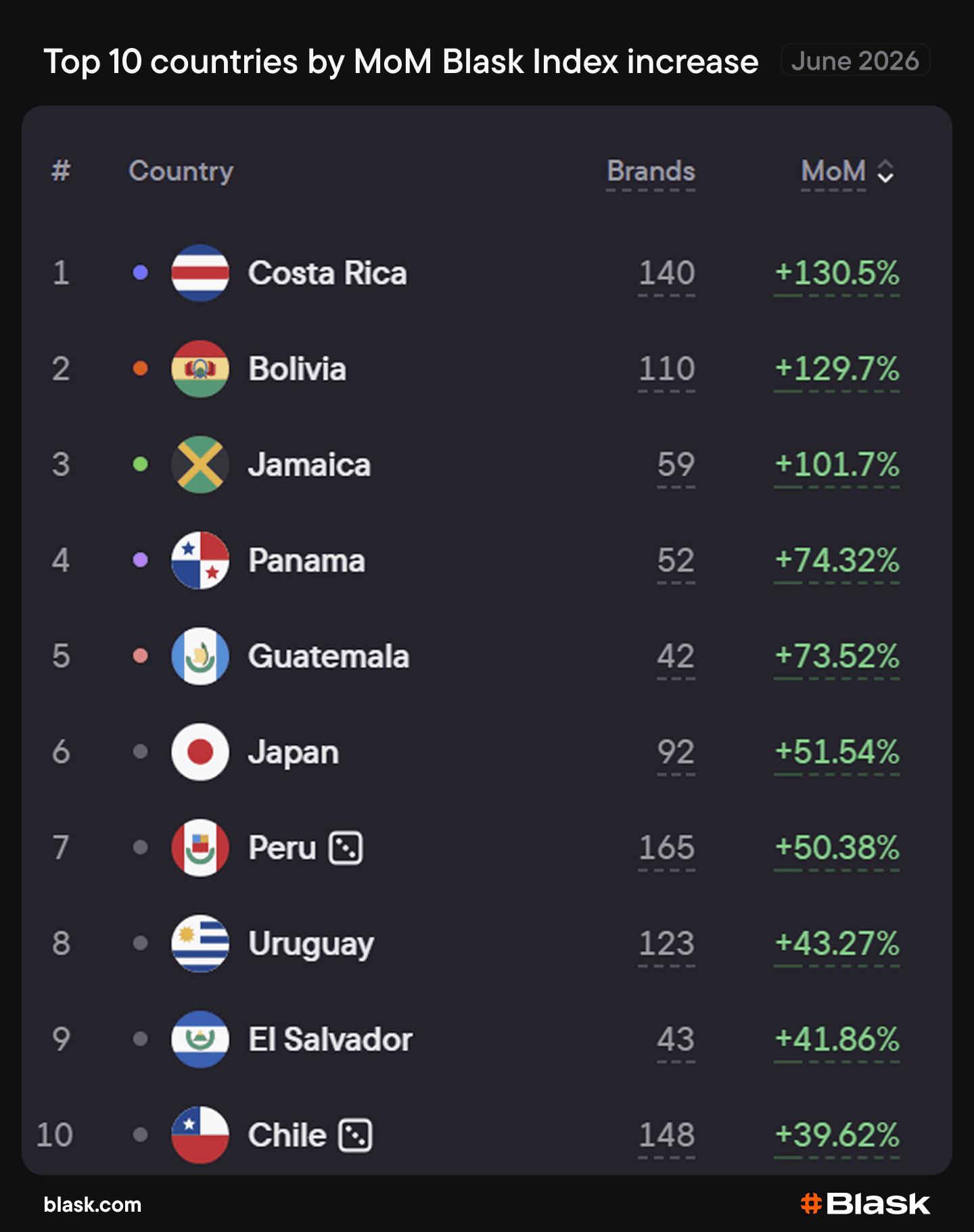
Latin American iGaming demand jumped 7.2 percent in June 2026 compared with May, more than 30 times the 0.2 percent growth recorded in the same period of 2025, according to new data from betting intelligence platform Blask. Eight of the world's ten fastest growing iGaming markets that month were in Latin America, with Bolivia and Costa Rica each roughly doubling demand as bettors across the region gear up for the 2026 FIFA World Cup.
Key facts: LatAm iGaming demand ahead of the World Cup
- Latin American iGaming demand rose 7.2 percent month over month in June 2026, versus 0.2 percent growth in June 2025, according to Blask's regional tracking.
- Bolivia's Blask Index doubled month over month, with 17 of its 134 active operators each recording at least a 100 percent jump in demand.
- Costa Rica also doubled demand overall, led by 11 brands whose individual index scores each doubled in June.
- Brazil, which accounts for roughly two thirds of regional iGaming demand, slipped 1.5 percent even as its unregulated offshore segment grew 2.8 percent.
- Colombia's licensed market fell 15 percent, with market leader BetPlay losing 46.9 percent of its demand.
Why did LatAm iGaming demand jump in June 2026?
Demand climbed because the region is entering World Cup season with a wave of newly regulated and newly active operators competing for attention, and because several Latin American nations either qualified for the tournament or are seeing spillover excitement from neighbors that did. Blask's data, drawn from its index of search and betting interest across 18 tracked Latin American markets, shows the June uplift was broad rather than confined to one or two countries, with eight of the top ten fastest growing markets worldwide located in the region.
Which Latin American countries grew the fastest in June 2026?
Bolivia and Costa Rica led the region, each effectively doubling their Blask Index scores month over month. Beyond those two, Blask found that six other countries with teams playing in the 2026 World Cup posted an aggregate index increase of 20.3 percent, pointing to a tournament effect layered on top of the region's broader growth trend.
Why did Bolivia's iGaming demand double in June?
Bolivia's surge was unusually broad based rather than driven by one dominant brand. Of the 134 active operators Blask tracks in the country, 17 individually doubled their demand index in June, a sign that smaller and mid sized operators are capturing a meaningful share of new bettor interest rather than a single market leader absorbing all of the growth.
What is driving Costa Rica's iGaming surge?
Costa Rica's demand also doubled, with 11 brands each seeing their index score double during the month. Costa Rica has long served as a licensing and operational hub for sportsbooks serving wider Latin American and international traffic, so a jump concentrated across a wide set of brands suggests the World Cup buildup is lifting activity across the country's operator base rather than a single new entrant.
Is Brazil's iGaming market slowing down?
Brazil's regulated market dipped slightly in June, with its Blask Index down 1.5 percent even as the offshore segment operating outside its licensing regime grew 2.8 percent. Brazil still represents about two thirds of all Latin American iGaming demand tracked by Blask, so a small percentage move there carries more weight than a larger swing in a smaller market. The divergence between the licensed and offshore trends is worth watching as Brazil's regulator continues to enforce its framework ahead of peak World Cup betting volume.
Why did Colombia's licensed iGaming market decline?
Colombia's Blask Index fell 15 percent in June, with the number of licensed operators active in the market down 10.2 percent and market leader BetPlay losing 46.9 percent of its demand. The scale of BetPlay's drop, given its position as the country's largest brand, is the single sharpest move in Blask's June dataset and suggests either a pullback in marketing spend, tighter compliance activity, or bettors shifting toward rival platforms ahead of the tournament.
How are Mexico's operators performing ahead of the World Cup?
Mexico's market showed a split picture. Bet365's Mexican operation saw user demand fall 31.3 percent, while newer entrant Playdoit posted a 59.4 percent demand gain over the same period, according to Blask. Mexico is one of the region's most competitive licensed markets, and a swing of that size between an established international brand and a fast growing local challenger points to real share shifting rather than overall category growth alone.
Are Panama and Uruguay benefiting from qualifying for the World Cup?
Panama and Uruguay are the two Latin American nations Blask tracked as directly qualified for the 2026 World Cup among the markets in its regional index, and both sit inside a broader group of participating nations that posted a combined 20.3 percent index increase in June. That points to a direct qualification effect on top of the region wide World Cup buildup already lifting demand in non qualifying markets like Bolivia and Costa Rica.
What is the Blask Index and how is it measured?
The Blask Index is a proprietary demand tracking metric that the data platform uses to measure relative betting and iGaming interest across markets and individual operator brands, drawing on search and platform activity signals rather than self reported operator revenue. Blask has separately built a real time World Cup interest tracker covering more than 45 nations globally, which the company's leadership has described as a way to visualize how attention shifts as the tournament progresses. Blask chief marketing officer Yana Makarochkina said of that broader World Cup tracking effort: "We track betting markets across 130+ countries. The World Cup puts that data to work: a fixed schedule, 48 nations, billions of people paying attention at the same time. We built the index so anyone can see where that attention moves as results come in," according to a report by European Gaming.
How does this compare to past World Cup tournaments?
Historical World Cup uplift data that Blask compiled for European markets shows the tournament has reliably moved acquisition numbers before, though the size of the effect varies widely by country and result. The Netherlands saw a 20.1 percent acquisition increase in 2022, translating to roughly 38,000 new players, while the United Kingdom saw a smaller 5.6 percent increase but a larger absolute pool of about 78,900 new players monthly given its scale. Latin America's June 2026 numbers, with entire national markets doubling, suggest the regional effect this cycle may be sharper than the incremental gains seen in some mature European markets during past tournaments.
| Market | June 2026 change | Notable detail |
|---|---|---|
| Bolivia | Index roughly doubled | 17 of 134 active operators each doubled demand |
| Costa Rica | Index roughly doubled | 11 brands each doubled their index score |
| Brazil | Down 1.5 percent (licensed) | Offshore segment up 2.8 percent; about two thirds of regional demand |
| Colombia | Down 15 percent | Licensed operator count down 10.2 percent; BetPlay down 46.9 percent |
| Mexico (Bet365) | Down 31.3 percent | Established international brand losing share |
| Mexico (Playdoit) | Up 59.4 percent | Local challenger brand gaining share |
| Panama and Uruguay group | Up 20.3 percent (aggregate, six qualifying nations) | Direct World Cup qualification effect |
What does this mean for operators eyeing Latin America?
The data points to a region where World Cup driven demand is real but unevenly distributed. Markets with broad based operator growth, like Bolivia and Costa Rica, suggest room for newer or smaller brands to win share during the tournament window, while Colombia's decline and Mexico's split results show that in more mature, competitive licensed markets the World Cup bump can just as easily reshuffle existing players as create new demand. Operators evaluating entry or expansion in the region will likely watch Brazil closely given its outsized share of total demand, and whether its regulated segment can close the gap with the growing offshore market once tournament betting volume peaks.
Frequently asked questions
How much did Latin American iGaming demand grow in June 2026?
Latin American iGaming demand grew 7.2 percent month over month in June 2026, according to Blask, compared with just 0.2 percent growth in the same month of 2025.
Which countries saw the biggest iGaming demand increases?
Bolivia and Costa Rica each roughly doubled their Blask Index scores in June 2026, the two fastest growing markets Blask tracks in the region.
Is Brazil's iGaming market growing or shrinking?
Brazil's licensed iGaming market slipped 1.5 percent in June 2026 even as its offshore, unlicensed segment grew 2.8 percent, according to Blask.
Why did BetPlay lose so much demand in Colombia?
Blask's June 2026 data shows BetPlay, Colombia's largest iGaming brand, lost 46.9 percent of its demand as the country's overall licensed market fell 15 percent and its number of active licensed operators dropped 10.2 percent.
What is driving the World Cup effect on iGaming demand?
Blask attributes the effect to a combination of national team qualification, regional football culture, and a fixed, widely watched tournament schedule that concentrates betting attention, according to comments from Blask chief marketing officer Yana Makarochkina reported by European Gaming.
More from iGaming Daily
Shane Hennen Pleads Guilty: What Federal Cooperation Could Mean for the NBA Gambling Scandal
365Prediction Eyes 2027 US Launch as Sports Event Contract Race Draws Compliance Warnings
Where Do World Cup Bettors Go After the Final Whistle?