New Zealand Online Casino Licences: EOI Opens for Up to 15 Operators
The Department of Internal Affairs has opened expressions of interest for New Zealand's first regulated online casino licences, with a 14 August deadline and an auction to follow.
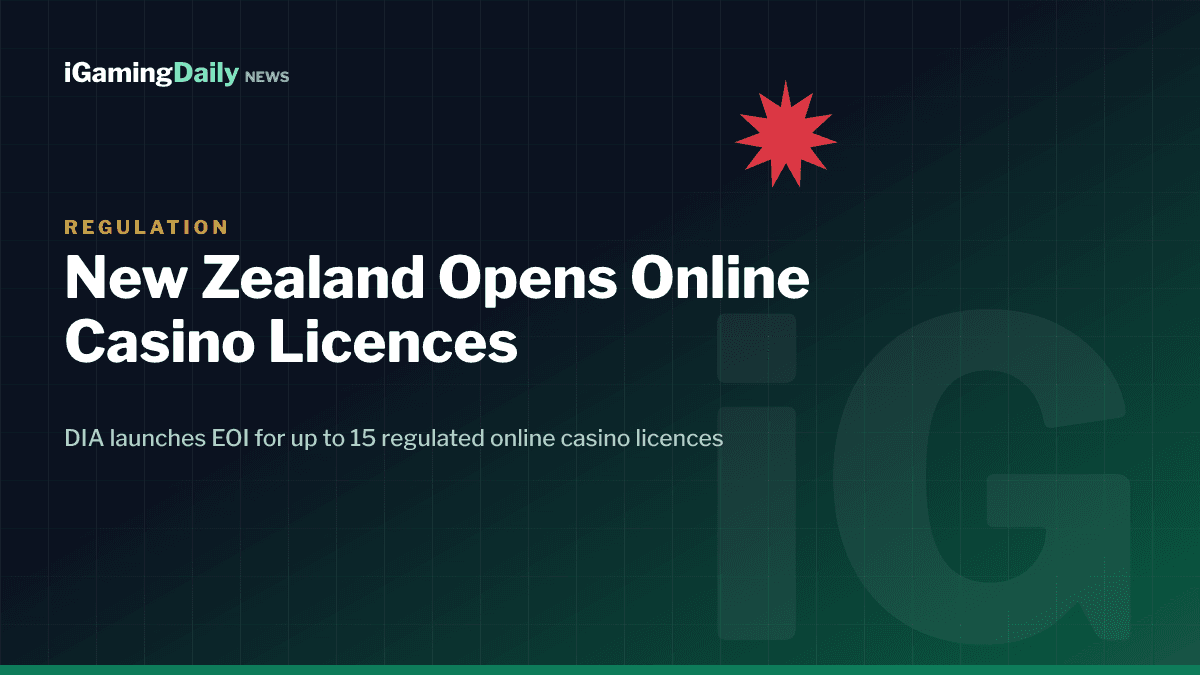
New Zealand opened expressions of interest (EOI) for its first regulated online casino licences on 17 July 2026, launching a three-stage process that will hand out up to 15 licences through a competitive auction. The Department of Internal Affairs (DIA) set an EOI deadline of 14 August 2026, with successful bidders required to file full applications by 1 December 2026 ahead of a market launch in the months that follow.
The move turns the Online Casino Gambling Act 2026 into a live licensing regime and marks the end of an unregulated era in which an estimated NZ$750 million flowed each year to offshore casino sites that paid no local tax and answered to no New Zealand regulator. For the first time, operators wanting to serve New Zealand players legally must bid for a place, meet strict harm-prevention rules and pay duty at home.
What did New Zealand announce on 17 July 2026?
The DIA formally opened the EOI window, the first of three stages in the new licensing system. Publicly notified on 16 July, the EOI invites operators to register their interest and submit entity and ownership documentation before the 14 August cut-off at 11:59pm New Zealand time. Only parties that clear the EOI stage will be eligible to take part in the auction that decides who wins one of the capped licences.
Key facts at a glance
- Regulator: Department of Internal Affairs (DIA)
- EOI opened: 17 July 2026
- EOI deadline: 14 August 2026, 11:59pm NZT
- Full application deadline: 1 December 2026
- Licences available: up to 15
- Licence term: up to 3 years, renewable subject to compliance
- Gaming duty: 12% on licensed operators
- Community funding levy: 4% of gross gaming revenue
- Maximum fine for breaches: NZ$5 million
- Estimated offshore spend today: NZ$750 million a year
How does the three-stage licensing process work?
New Zealand has deliberately avoided an open-ended register. Instead, the DIA is running a funnel. Stage one is the EOI, where operators prove they are a credible, financially sound entity. Stage two is an auction, expected within roughly a month of the EOI closing, in which qualified bidders compete for the limited licences. Stage three is a detailed application and compliance assessment, running four to six months, in which winning bidders must satisfy the DIA on player protection, technology standards and anti-money-laundering controls before going live.
How many online casino licences are available?
The cap is a maximum of 15 licences. That scarcity is the point: by keeping the number low and auctioning access, the government aims to attract established, well-capitalised operators rather than a long tail of smaller sites that are harder to police. Each licence runs for up to three years initially and can be renewed if the holder stays compliant.
What documents do operators need for the EOI?
The EOI stage is document-heavy. At entity level, applicants must supply corporate documentation, a current ownership structure diagram, a management structure diagram, evidence of capital and its sources, and a certified credit check. For every key officer, the DIA wants certified photographic identification, a criminal record check and a certified credit report. Applications are processed through the Government Electronic Tenders Service, and the department has encouraged pre-registration to avoid a last-minute crush.
How much tax will licensed operators pay?
Licensed operators face a gaming duty of 12%, alongside a community funding requirement set at 4% of gross gaming revenue that is earmarked for harm prevention and public-good spending. Officials have estimated the regime will generate between NZ$10 million and NZ$20 million in government revenue in its first 12 months, a figure that is expected to rise as offshore play migrates into the regulated market.
What happens to offshore and unlicensed operators?
The regime is built to end the offshore free ride. Sites that fail to secure a licence must stop serving New Zealand players once the process concludes or face enforcement. Breaches of the new rules carry fines of up to NZ$5 million, and unlicensed operators risk being pushed out of the market entirely. The government has framed the reform around what officials describe as the fundamental policy challenge of moving consumers from unlicensed sites into a channel where they are protected.
What player-protection rules come with the licences?
Harm minimisation sits at the centre of the Act. Licence holders must run robust age-verification so that only adults can play, and advertising rules restrict marketing that could reach children. Policymakers have repeatedly cited evidence that offshore play is concentrated among younger men and some ethnic groups in more deprived areas, and the 4% community levy is designed to fund treatment and prevention services that target exactly those harms.
Why does this matter for the wider iGaming industry?
New Zealand is one of the last developed English-speaking markets to move from prohibition-by-omission to a formal online casino framework, so the auction will be closely watched. A capped, high-bar regime rewards scale, which favours the large international groups that can absorb duty, compliance costs and an upfront auction price. It also creates a template other jurisdictions weighing licence caps versus open registers will study.
How does New Zealand compare with other 2026 licensing moves?
The timing puts New Zealand alongside a busy year of new-market openings. Canada's Alberta iGaming market launched with 50 operators on 13 July 2026, taking an open, multi-operator route rather than a hard cap. Africa saw Angola open a 30-day gambling licensing window, while Georgia is set to reveal its iGaming export licence regime in August 2026. New Zealand's capped auction sits at the more restrictive end of that spectrum.
New Zealand online casino regime: at a glance
| Feature | Detail |
|---|---|
| Legislation | Online Casino Gambling Act 2026 |
| Regulator | Department of Internal Affairs |
| Process | EOI, then auction, then full application |
| Licences | Up to 15 |
| Gaming duty | 12% |
| Community levy | 4% of GGR |
| Maximum fine | NZ$5 million |
| EOI deadline | 14 August 2026 |
| Application deadline | 1 December 2026 |
What are the key dates operators must hit?
The technology standards were published on 7 July 2026, the EOI opened on 17 July and closes on 14 August, and full applications are due by 1 December. Between the EOI close and the application deadline, the auction and eligibility checks take place, meaning operators serious about New Zealand need their corporate, financial and compliance paperwork ready now rather than closer to launch.
Who is likely to bid for a New Zealand licence?
With only 15 slots and an auction price attached, the field is expected to lean toward large international operators and content suppliers already active in regulated markets, many of whom have watched New Zealand player spend leak offshore for years. Exact bidders will not be clear until the auction stage, and the DIA has not published a list of interested parties.
Frequently asked questions
When did New Zealand open online casino licence applications?
The expression of interest window opened on 17 July 2026 and closes on 14 August 2026. Full applications from successful bidders are due by 1 December 2026.
How many online casino licences will New Zealand issue?
Up to 15 licences will be available, allocated through a competitive auction after the EOI stage.
How much tax will New Zealand online casinos pay?
Licensed operators face a 12% gaming duty plus a 4% of gross gaming revenue community funding levy for harm prevention.
What happens to offshore casinos serving New Zealand?
Operators that do not win a licence must stop serving New Zealand players, with breaches punishable by fines of up to NZ$5 million.
Who regulates online casinos in New Zealand?
The Department of Internal Affairs administers the regime under the Online Casino Gambling Act 2026.
Updated July 2026. Sources: Department of Internal Affairs EOI guidance, iGaming Business and SlotBeats.
More from iGaming Daily
Cambodia Shuts 72 of 195 Licensed Casinos in Year-Long Online Fraud Crackdown
Poland's 12% Turnover Tax Is Driving Players to Illegal Online Casinos

PAGCOR Privatization Could Cost Philippines Healthcare P2.1 Billion a Year